
On November 14, 2025, the 7th Subcommittee Meeting to Study the Use of Digital Tools for Food Labelling (Japanese) was held. A draft summary was presented at the meeting outlining the key issues surrounding this digital shift. Here are the key points from that summary worth noting.
(Note: For the background of this review, please refer to our past article)
Decentralized management is considered appropriate for labelling data management
Two methods were presented for managing data used in labelling:
(1) Centralized management: Data is registered and stored in a single database maintained by the government or a relevant authority.
(2) Decentralized management: Each business operator maintains its own database, in accordance with rules established by the government or authority. Considering the design costs and the effective utilization of businesses’ existing databases, decentralized management has been deemed the more appropriate basis for system design.
Specific methods
The draft summary states that the decision to substitute certain mandatory labelling elements on packaging with digital tools should be left to the discretion of businesses.
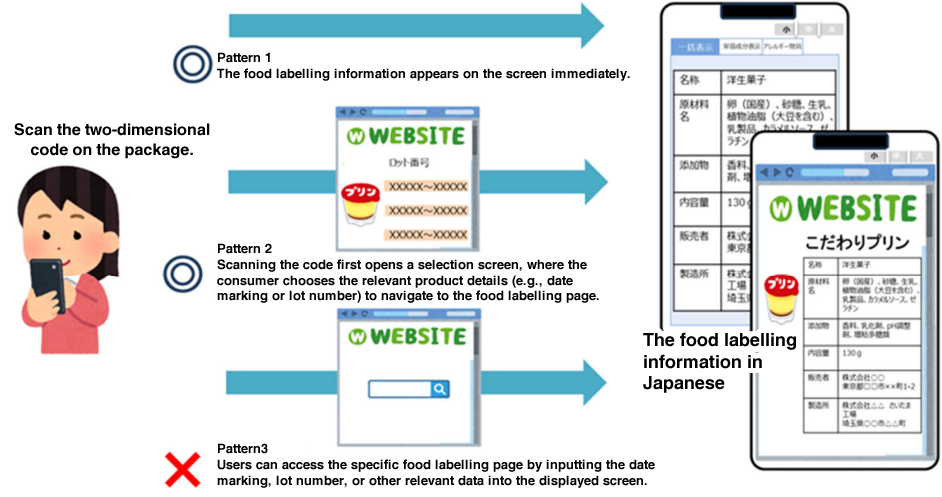
The proposed system is based on consumers using their personal smartphones to scan a two-dimensional code and access the necessary food labelling information. Three possible patterns were presented (as shown in the figure). Based on the principle that “Consumers must be able to easily access technologically presented food information without having to provide or disclose any personal data”, pattern ① or ② are considered suitable.
Separation from advertising content
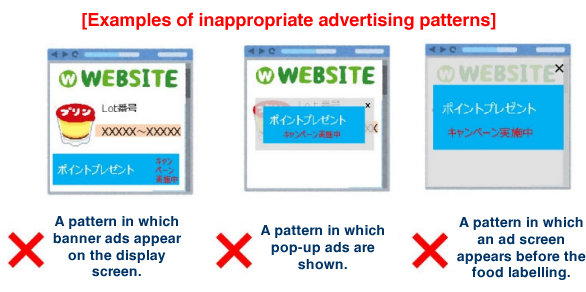
Given current food container and packaging practices, advertising on digital tool–based platforms is considered acceptable, provided that delivering the food labelling information remains the primary purpose and the advertising does not interfere with access to that information.
On the other hand, advertisements appearing in ways that hinder the visibility of the food labelling are undesirable. This includes, for example, appearing before the labelling content is displayed, standing out more than the labelling, or intruding into the mandatory information panel.
The need for a system that allows administrative authorities to properly monitor update histories
While the use of digital tools makes it easier for businesses to update information, it also raises concerns that errors could be erased without any external means of verification, potentially disadvantaging consumers. Accordingly, it will be necessary to consider how update histories should be maintained and disclosed in parallel.
Future schedule
The Subcommittee’s discussions are planned to be completed once the summary of its deliberations is reported to the Food Labeling Discussion Meeting. The focus will then shift to developing and verifying specific guidelines from next fiscal year.
In addition, the Food Labelling Discussion Meeting is anticipated to hold specific deliberations regarding which labelling items must remain on the physical container and packages and which can be replaced by utilizing digital tools.
Share/Like/Follow:








Newsletter Signup
We issue monthly e-newsletters, which provide you with the latest updates on food labeling/regulations in Japan.
If you want to make sure to not miss any issue, please click below.

Related Service
Research Services on Ingredients & Food Labeling -For the Japanese Market-
We verify the conformity of ingredients and additives with the standards for use in Japan based on specifications such as formulation lists. We also verify the conformity of the proposed labeling of ingredient names, nutrients, etc. with the labeling standards based on specifications such as formulation lists.

Label bank Co., Ltd. Regulatory Review and Development
Born in Japan. Specializing in biochemistry, he is engaged in research work on ingredients and additives imported to Japan from overseas, and provides consulting services on food standards, additives, and food labeling.